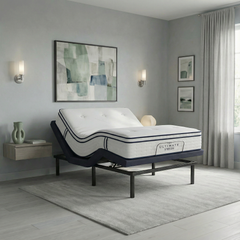
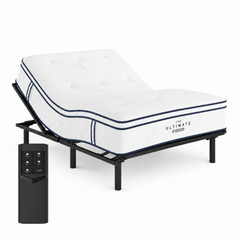
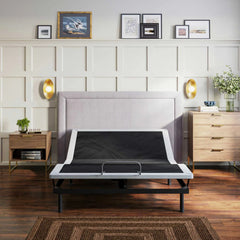
15% OFF SITEWIDE + FREE ADJUSTABLE BASE USE CODE LABOR

Limited time only and while supplies last

THE ULTIMATE SNOOZE

Human Biologist Gary Brecka Spent Years Telling People To Clean Up Their Inputs. Then He Looked At The Bed.

Filter the water. Read the labels. Fix the light, the air, the breath. He'd built a career on the boring fundamentals, and people kept asking him the one question he couldn't answer well: what mattress should I buy? Nothing on the market was what he wanted to recommend, so he co-founded The Ultimate Snooze and had it built instead.

By Marin Delacroix
Health & Home Correspondent · August 2026
Certified Organic LatexNo FiberglassNo Polyurethane Foam100-Night Trial

Gary Brecka has built a career on a simple, unglamorous idea: fix the inputs. Water, light, air, food, breath. The boring fundamentals, done properly, before anything exotic.

Which is why, he told me, the mattress question kept bothering him. People asked it constantly, and the honest answer was that he'd send them looking for an ingredient list that didn't exist. They'd come back with marketing words. So rather than keep recommending, he went and had one built. That's how The Ultimate Snooze started.

Let's start with the number that convinced him.

You will spend roughly one-third of your entire life on your mattress. If you live to 80, that's about 26 years. Twenty-six years of lying still, breathing deeply, with your face inches from the same surface.

Now here's the part that gets strange.

You have probably researched your olive oil more carefully than your mattress. Most people have. We can tell you the sourcing of our coffee beans and the filtration on our water, and then sleep for a quarter-century on a slab of polyurethane foam whose ingredient list we've never seen and couldn't read if we had.

That's not a character flaw. It's a labeling problem. Mattress ingredient disclosure is not mandatory. There is no nutrition panel on a bed.

So researchers went and measured it themselves.

02

The air above your mattress is
its own little weather system

Sleep scientists have a name for the pocket of air between your body and your bed: the sleeping microenvironment.

It's warmer than the room. It's more humid than the room. It has more carbon dioxide than the room. And critically, it's where your face is.

That last part is the whole ballgame. Whatever a mattress releases doesn't have to travel far to reach you. It's already there. You're lying in it, inhaling it, for eight hours, every night, for years.

Researchers at UT Austin measured this directly in crib mattresses and found chemical emissions were strongest in the sleeper's immediate breathing zone, not spread evenly around the room, but concentrated right where the nose is. Later work found VOC concentrations at the mattress surface running roughly double what you'd measure a few feet away.

In plain English: Your bedroom air quality reading is not your sleeping air quality reading. The mattress makes its own microclimate, and you're the one inside it.

The Sleeping Microenvironment
Warmer · more humid · higher CO₂, and it is exactly where your face is.

"Literally have never slept better! I wonder, what's the point of tracking everything in our lives if we are still going to spend a third of it on a toxic mattress? We need to start tracking what we living in and on as well.

This is more than a super comfortable mattress, this is a real investment in the future of you and your family's sleep. Thank you to the TUS team for making this product and for changing the way I sleep, forever."

Tessa· Verified Buyer · May 2026
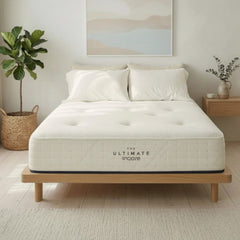
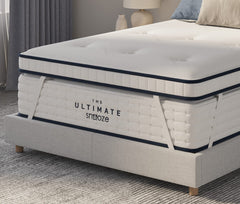
Pillow Top Organic Latex Mattress
03 · WHAT THE 2025 RESEARCH FOUND

Two peer-reviewed studies. Same conclusion.

In April 2025, researchers from the University of Toronto published a pair of studies. They are the most direct look anyone has taken at this question.

Study one measured the air in 25 real children's bedrooms in Toronto and Ottawa. They found dozens of compounds, phthalates, flame retardants, and UV-filter chemicals. The highest concentrations weren't at the window or the door. They were around the bed.

Study two went looking for the source. The team bought 16 brand-new children's mattresses and tested them in a chamber that simulated a real sleeping child, body weight, body temperature, movement.

21

semi-volatile organic compounds detected coming off new mattresses

16 brand-new mattresses tested

One exceeded Canada's regulatory limit for a phthalate in children's mattresses. Five contained levels of phthalates above 0.1% that are regulated in children's toys but not regulated in mattresses at all.

That last sentence is worth reading twice. The same chemical, at the same concentration, is restricted in a plastic toy your child holds for ten minutes, and unrestricted in the mattress they lie on for ten hours.

The researchers' own framing was that these findings underscore mattresses as a significant source in children's sleeping environments, particularly concerning given how much time children spend asleep.

In plain English: New mattresses off-gas. Researchers went looking for it, found it, and traced it back to the bed itself.

These studies tested children's mattresses. We cite them as what independent researchers found when testing conventional mattresses, not as a test of any named brand.

04 · YOUR OWN BODY HEAT

Off-gassing isn't a one-time event. It's a nightly one.

Here's the assumption almost everyone makes: "New mattress smells for a week, then it's done." The research says otherwise.

In 2019, a team published a study in Environmental Science & Technology testing eight polyurethane mattresses. They didn't test them sitting cold in a warehouse. They tested them under simulated sleeping conditions, matched body temperature, matched humidity, matched CO₂.

The finding: VOC emissions increased significantly under sleeping conditions. And when they isolated the variables, heat was the dominant factor, more than humidity, more than CO₂.

An earlier UT Austin study on crib mattresses found the same pattern: emissions at body temperature (36°C) ran substantially higher than at room temperature (23°C). Some estimates put the increase at roughly 2.5×.

Drag to compare, emissions at room temperature vs. under a sleeping body

Read that as a mechanism, because that's what it is: you lie down → the foam warms up → the foam releases more → and your face is directly above it

The bed does the least when nobody's in it. It does the most when you are.

"I love it! Sleeping great and the peace of mind knowing I am not breathing in those horrible gases from the conventional mattress!"

Phillip P.Wilmington, NC · Verified Buyer · May 2026
05 · FIBERGLASS

There may be glass fibers inside your mattress right now.

This one is less about slow exposure and more about a specific, well-documented failure mode.

US mattresses must pass a federal open-flame test, 16 CFR Part 1633. Two propane burners, 70 seconds on top, 50 seconds on the side, then 30 minutes of monitoring. It's a serious standard and it exists for a good reason: mattress fires kill people.

The question is how you pass it.

The cheap way is a fiberglass sock, a woven glass-fiber sleeve wrapped around the foam core, under the outer cover. It works. It's inexpensive. And it has generated one of the more remarkable stretches of consumer litigation in the furniture industry.

Fiberglass sock
CLOUDWOOL™ organic wool
What's on the record

One major boxed-mattress brand has faced multiple class actions alleging its mattresses can expel glass fibers, with attorneys in one filing stating they represented more than 2,000 individuals claiming injury.

A national furniture retailer and its mattress affiliates agreed to a $9,000,000 settlement covering mattresses containing fiberglass in the inner sock, purchased between October 2017 and June 2024. Preliminary approval came in March 2026; final approval hearing set for September 2026.

A separate proposed class action against another manufacturer alleges fiberglass can leak into homes through normal use. One filing noted a mattress tag listing glass fiber at 23% with no warning that the material could escape.

Court filings describe remediation as extraordinarily difficult, fibers travel through ventilation and settle into carpet, drapery, clothing, and furniture, described in one complaint as "virtually impossible" to remove once dispersed. Reported cleanup estimates have run into the tens of thousands of dollars, with some households vacating their homes entirely.

In plain English: Some mattresses pass the fire test by wrapping the foam in glass. When that sleeve fails, often when someone unzips the cover to wash it, which the cover invites you to do, the glass gets into the house. And it does not come back out easily.

So how do you pass a fire test without glass or chemicals

You use wool.

Wool is naturally fire-resistant. It has high moisture content and a high nitrogen content, it doesn't melt or drip, and it chars and self-extinguishes rather than feeding a flame. Neither the US open-flame standard nor Canada's smoulder standard mandates chemical treatment, they specify a performance outcome, and a dense wool barrier can achieve it.

It's the oldest fire barrier there is. It just costs more than glass.

06 · WHY FOAM SLEEPS HOT

Falling asleep is a cooling event.

Most people think of "sleeping hot" as a comfort complaint. It's a physiology problem.

Roughly two hours before your usual bedtime, your body starts dilating blood vessels in your hands and feet, pushing heat outward and away from your core. Core body temperature falls, and that decline is not a side effect of falling asleep. It's one of the primary biological signals that initiates sleep.

The research is consistent on this. Core temperature decline precedes sleep onset. Promoting heat loss from the skin surface, especially the hands and feet, speeds up sleep onset and improves sleep quality. And when heat loss is blocked, the consequences are measurable: longer time to fall asleep, less slow-wave (deep) sleep, and more fragmented sleep.

There's a second wrinkle. During REM sleep, your body largely suspends its thermoregulatory defenses, you mostly stop sweating and shivering to correct your temperature. REM is the stage most vulnerable to a hot sleeping surface. A bed that traps heat doesn't just make you uncomfortable. It preferentially attacks the sleep stage you have the least ability to defend.

Now consider what memory foam is designed to do.

Memory foam works by conforming, it softens with your body heat and molds around you, maximizing surface contact. That's the entire selling point.

It's also, structurally, the opposite of what heat dissipation requires. More contact area, less airflow, a closed-cell structure that holds warmth against you. The material's core feature and its core failure are the same property.

In plain English: Your body is trying to shed heat so it can fall asleep. Memory foam is engineered to hug you and hold that heat in. You are fighting your own mattress.

Memory foam, closed cell
Air stalls at the surface. Heat accumulates.
Pinhole latex, open cell
Air moves. Heat leaves.

What latex does differently

Natural latex is open-cell and, in this mattress, pinhole-perforated, thousands of channels running through the material. It responds to pressure instead of melting into it, so it supports without the deep sink that buries you in the surface.

Air moves. Heat leaves.

07 · MOISTURE

You release about a pint of water a night. Where does it go?

An average adult loses meaningful moisture overnight through sweat and respiration. That water has to go somewhere. It goes into your sheets, and then into your mattress. In a breathable mattress, it moves through and evaporates. In a dense foam mattress, it lingers.

Mold. Mold spores are present in essentially every indoor environment, you cannot eliminate them. What determines whether they grow is moisture. Guidance generally puts the safe zone below 60% relative humidity, ideally 40–50%. A dense foam core that traps moisture in a poorly ventilated room is a reasonable description of an incubator.

Dust mites. These are the more common problem. Dust mites need humidity to survive, they draw water directly from the air rather than drinking it. Research has found that even short daily spells of elevated humidity are enough to keep them alive and reproducing, even when ambient room air is otherwise too dry for them. And where does that daily humid spell come from? You.

40.5%

of uncovered foam mattresses had detectable mite allergen

12.5%

of spring mattresses, in the same study of 152 homes

Why wool and latex change this equation

Wool is the most hygroscopic common textile fiber on earth. Dry wool can absorb roughly 35% of its own weight in moisture from saturated air, compared to about 24% for cotton and under 1% for polyester. It pulls moisture off your skin, holds it inside the fiber, and releases it gradually. It also contains lanolin, which creates an unfavorable environment for mites.

Latex is naturally resistant to mold, mildew, and dust mite colonization, and its open structure lets moisture pass rather than pool.

Steel coils, instead of a solid foam base, leave an open air chamber under you that lets the whole system breathe from below.

In plain English: A foam mattress absorbs your nightly moisture and holds it. A cotton-wool-latex-and-coil mattress moves it through and lets it out.

Organic cotton cover
Wool, absorbs & disperses laterally
Pinhole latex, passes through
Open coil chamber, dissipates
Scroll to follow the moisture through the stack
08 · THE FOUR INGREDIENTS

Nothing here was invented in a lab. All of it was invented by evolution.

Latex, from rubber trees

Tapped from Hevea brasiliensis. It’s sap. Open-cell, springy, responsive, it pushes back instead of swallowing you. Naturally resistant to mold, mildew, and dust mites.

Wool, from sheep

The most sophisticated thermoregulating fiber that exists. Warm when you’re cold, cool when you’re hot, and naturally flame-resistant, which is how you pass a federal fire test without glass fiber.

Cotton, from fields

Soft, breathable, familiar against skin. When it’s certified organic, it’s grown without the pesticide and processing chemical load of conventional cotton.

Steel, from the ground

Pocketed coils. Each moves independently, so your partner’s 3am rollover doesn’t reach you. Structurally, coils create an open air chamber, the opposite of a solid foam slab.

09 · INSIDE THE PILLOWTOP

Four layers. Hand-tufted. No glue.

"If deep sleep and true recovery matter to you, this is the mattress I would choose for my own home. The impact on breathing and circulation is real."

Gary Brecka, Human Biologist
LAYER 1: ORGANIC AIR™ Certified Organic Cotton Cover

The surface against your skin. Soft, breathable, familiar. Nothing between you and it.

LAYER 2: CLOUDWOOL™ Organic Wool Fire Barrier

The layer doing the most work: temperature regulator, moisture manager, and fire barrier, all at once, without chemicals, and without a single glass fiber.

LAYER 3: 4" Organic Latex Comfort Layer

Pinhole-perforated for airflow. Contours without the sink. You rest on it, not in it.

LAYER 4: SupportWave™ 1,100-Count 5-Zone Pocketed Coils

Softer at the shoulders, firmer through the lumbar, with reinforced edges so you can use the whole mattress instead of the middle 70% of it.

10 · SIDE BY SIDE

The same bed, two ingredient lists.

Gary Brecka Pillowtop
Typical foam / boxed mattress
Comfort material

Organic latex (tree sap)

Polyurethane foam (petroleum)

Fire barrier

Organic wool, naturally flame-resistant

Fiberglass sock or chemical treatment

Fiberglass

Zero

Common in budget and mid-tier

Adhesives

None, hand-tufted

Glue between layers

Airflow

Pinhole latex + open coil chamber

Closed-cell, minimal airflow

Heat behavior

Dissipates

Traps and holds

Moisture

Wool absorbs and releases

Foam absorbs and retains

Support base

1,100 pocketed coils, 5 zones

Solid foam slab

Certifications

Certified Organic Latex

Frequently none

Typical lifespan

Built for decades

5–10 years

Warranty & trial

30 years · 100 nights

Commonly 10 years · varies

11 · A BUYING GUIDE

How not to get scammed by the word "natural"

"Natural." "Eco." "Green." "Plant-based." "Non-toxic." None of these words are regulated. A mattress can be 95% polyurethane foam and legally call itself natural because there's a bit of plant oil in the mix.

Here's what's verifiable.

Certified Organic Latex
Third-party certified

Certified organic raw latex, restricted fillers, annual supply-chain audits. This is what separates organic latex from merely natural latex.

Certified Organic Cotton & Wool
Third-party certified textiles

Covers cotton covers and wool batting. Also restricts dyes and finishing agents.

OEKO-TEX 100
Standard 100

Tests the finished product for harmful substances, pesticides, heavy metals, formaldehyde, phthalates, certain flame retardants.

The four questions to ask any mattress company

  1. Is there fiberglass anywhere in this mattress? Ask directly. Ask for it in writing.
  2. What is the fire barrier made of? If they can't answer in one sentence, that's your answer.
  3. Is the latex Certified Organic Latex, or just "natural"? Very different claims.
  4. Are the layers glued or tufted?

If a company gets defensive about any of these, you've learned what you needed to learn.

12 · REAL PEOPLE, REAL BEDS

4.6 average review rating.

Across our mattress lineup. Here's what people write when they've slept on it.

"I am beyond impressed with this mattress. It's the perfect mix of comfort and support, and I've genuinely been sleeping better since we got it. The quality feels incredible, it stays cool at night, and waking up without aches has been a game changer.

I was honestly skeptical that anything could compare comfort-wise because we were previously sleeping on a top-of-the-line Tempur-Pedic, but this mattress has completely exceeded my expectations. Best purchase we've made for our home in a long time!"

ChloeCharlotte, NC · Verified Buyer · May 2026
Pillow Top Organic Latex Mattress
Highly Recommended

"I had a great experience with Mitchell and Ultimate Snooze. From the start, Mitchell was knowledgeable, helpful, and never pushy. He took the time to explain the benefits of the mattress and even helped me call Mattress Firm to process the return of my old mattress. …

His communication has been excellent throughout the entire process. I love my new mattress. It's a huge improvement over the Tempur-Pedic I had before and cost significantly less. I'm very happy with my purchase and the customer service I received."

Stacy VerdreamSt. Cloud, FL · Verified Buyer · July 2026
Pillow Top Organic Latex Mattress
Great mattress great quality

"Much better quality than my other mattress much more comfortable! Great peace of mind to know that it's made of organic material and not toxic chemicals and materials! Highly recommend!"

John MastroianniCambridge, MA · Verified Buyer · August 2026
Pillow Top Organic Latex Mattress

"I wish I could give this 10 stars! My sleep has dramatically improved with no questions asked! It is definitely something to dive into at the end of the day as we know proper rest is a super human power!"

Drew StewartVerified Buyer · July 2026
Pillow Top Organic Latex Mattress
13 · "OKAY, BUT..."

The objections, answered.

"This is expensive.", it is. Here's the math.
96¢
per night if you keep it only 10 years
32¢
per night across the 30-year warranty
$3,519
Queen at 20% off, one purchase, not five

A cheap foam mattress at $800 replaced every 6 years runs about 37¢ a night, and you'll buy five of them over the same window, spend a month each time waiting for it to stop smelling, and sleep the last two years of each one in a body-shaped trough. You're not comparing $3,500 to $800. You're comparing one purchase to five.

"Similar 'clean' mattress in our local store was twice the price. You can't beat this package deal. Knowing you are sleeping on a mattress that was designed to improve your health, provides peace of mind."

Sarah Black· Boca Raton, FL · Verified Buyer · June 2026
Verified purchase, Ultimate Snooze sleep system with adjustable base (bundle; vibration and pillows not included with the mattress alone)

That's usually all-latex construction you're thinking of. This is a hybrid, and it's the plush model, 6/10 on a 10-point scale. Four inches of latex on a zoned coil system gives you the pressure relief of a plush pillowtop with actual support underneath, rather than the sink-and-stay of memory foam. Side sleepers do particularly well on it.

Worth taking seriously and worth talking to your doctor about. Latex allergy is a reaction to specific proteins in natural rubber, and the vast majority of documented cases involve direct skin contact with thin dipped-latex products, gloves, balloons, medical devices. In this mattress the latex sits under a wool layer and an organic cotton cover, so there's no direct contact. Washed, vulcanized foam latex also carries a substantially reduced protein load. That said: if you have a diagnosed latex allergy, ask your physician before ordering, and use the 100-night trial.

It arrives compressed and boxed, and it expands over 4–8 hours. You may notice a faint natural rubber smell, that's the latex itself, and it fades. What isn't happening is the polyurethane, adhesive, and flame-retardant off-gassing profile described in the research above, because those materials aren't in the mattress.

100 nights. There's a 30-day break-in period built in, real mattress adaptation takes about two weeks and your body needs the runway. Between day 31 and day 100 you're eligible for a full refund (a $199 processing fee applies in some cases).

30-year warranty on craftsmanship and structural integrity. The tufted, no-glue construction is a large part of why that number is possible, there's no adhesive bond to fail and no foam layer to compress into permanent memory.

14 · THE OFFER

Take 20% off the Gary Brecka Pillowtop.

You save$1,540.00
  • 100-night risk-free trial, includes a 30-day break-in
  • 30-year warranty on craftsmanship and structural integrity
  • Free US shipping
  • HSA/FSA eligible
  • Handcrafted in the USA, ships from Georgia
  • White-glove setup available (+$299)

"The most attentive customer service. Products are high quality and non toxic, two very important qualities. Life long mattress with incredible warranty."

MistileeTracy, CA · Verified Buyer · June 2026
Verified purchase, The Ultimate Sleep System, Elite

No fiberglass. No polyurethane foam. No chemical flame retardants. No glue.
Cotton, wool, latex, and steel.

You're going to spend 26 years there. Spend them on something that came out of the ground.
  1. Vaezafshar, S. et al. (2025). Are Sleeping Children Exposed to Plasticizers, Flame Retardants, and UV-Filters from Their Mattresses? Environmental Science & Technology, 59(16), 7909–7918.
  2. Young Children's Exposure to Chemicals of Concern in Their Sleeping Environment: An In-Home Study. Environmental Science & Technology Letters (2025). University of Toronto
  3. Oz, K. et al. (2019). Volatile Organic Compound Emissions from Polyurethane Mattresses under Variable Environmental Conditions. Environmental Science & Technology.
  4. Boor, B. E., Järnström, H., Novoselac, A., Xu, Y. (2014). Infant Exposure to Emissions of Volatile Organic Compounds from Crib Mattresses. Environmental Science & Technology. (UT Austin Cockrell School)
  5. Chow, C. M. et al. (2019). The Impact of Sleepwear Fiber Type on Sleep Quality Under Warm Ambient Conditions. Nature and Science of Sleep, 11, 167
  6. Shin, M. et al. (2016). The effects of fabric for sleepwear and bedding on sleep at ambient temperatures of 17°C and 22°C. Nature and Science of Sleep.
  7. A systematic review of ambient heat and sleep in a warming climate. Sleep Medicine Reviews (2024).
  8. Munir, A. K. et al. House-dust mites and mattresses. PubMed ID 12028120.
  9. Mattresses as a winter refuge for house-dust mite populations. PubMed ID 9140520.
  10. U.S. Consumer Product Safety Commission. 16 CFR Part 1633, Standard for the Flammability (Open Flame) of Mattress Sets.
  11. Court records: Aldrich v. Resident Home, LLC et al., Case No. 5:25-cv-01791, C.D. Cal.
  12. Ashley Furniture / Resident Home fiberglass class action settlement, $9,000,000, preliminary approval March 19, 2026.
  13. Control Union Certifications, certified organic latex criteria.
  14. Global Standard gGmbH, certified organic textile criteria.

Advertisement. Cited studies tested children's mattresses and conventional polyurethane mattresses; they are not tests of any named competitor product. Material and construction claims describe this product. This page is not medical advice.