



By Jacob Rivera, Creative Director at The Ultimate Snooze
If you have been sleeping on a mattress that is not quite right — too firm, too warm, no longer as comfortable as it was when you bought it — a mattress topper is probably on your radar. The question is whether it will actually solve the problem or just add a layer of padding that delays the real decision.
The honest answer: it depends on what is wrong with the mattress, what the topper is made of, and what you are expecting it to do. Here is the complete breakdown.
What a Mattress Topper Can Actually Fix
A mattress that is too firm: This is the ideal topper use case. If the underlying mattress has solid structural integrity — meaning it has not sagged, the coils or core are still functioning correctly, and the support layer is doing its job — but the comfort layer is simply firmer than your preference, a quality topper adds the missing softness without undermining the support beneath it.
Surface comfort that has worn down: The comfort layers of most mattresses compress over time. The support layer beneath may still be functional. A topper can effectively restore the feel of a newer mattress by adding a fresh comfort layer over a still-adequate foundation.
Temperature: If the mattress surface traps heat, a breathable topper can meaningfully change the thermal experience of sleep. This is one of the most underrated use cases — particularly for people sleeping on dense memory foam who do not want to replace the mattress entirely.
Pressure relief for specific sleep positions: A plush topper can add meaningful shoulder and hip pressure relief for side sleepers on firmer surfaces, reducing the ache that comes from a contact point that is not quite soft enough.
What a Mattress Topper Cannot Fix
A structurally compromised mattress: If the mattress has sagged, if the coils have lost their response, or if the core has degraded — a topper does not address any of that. You will simply be sleeping on a soft topper over a broken foundation, and the body impression and lack of support will continue to affect your spine alignment and sleep quality. A topper over a failing mattress is a delay, not a solution.
The chemical environment of the mattress beneath it: This is the one most people do not think about. If the mattress below a topper is off-gassing VOCs from polyurethane foam, those compounds do not stop at the topper layer. They continue to circulate in the sleep microenvironment — the air immediately around your body for eight hours a night. A conventional polyester or foam topper does nothing about that and may add its own off-gassing on top. The NIEHS documents that VOC compounds from synthetic bedding materials are inhaled during sleep at meaningful concentrations, with effects on the endocrine and respiratory systems at household exposure levels.
A mattress that is wrong for your body type or sleep position: If the mattress architecture — firmness zones, support distribution, depth — is fundamentally misaligned with how you sleep, adding a thin comfort layer addresses the surface symptom without touching the structural mismatch.
Why the Material of the Topper Matters More Than Most People Realize
Not all toppers are doing the same thing, and the materials question goes beyond feel.
Memory foam toppers: Soft, contouring, and inexpensive relative to latex alternatives. They also off-gas the same isocyanate compounds and formaldehyde-releasing agents as memory foam mattresses. They trap heat. They retain moisture. They are, in terms of the chemical sleep environment, an extension of the same problem present in a foam mattress.
Polyester fiber toppers: Soft but not supportive. They compress quickly under body weight, redistribute to the edges, and create uneven surfaces within months. From a materials standpoint, polyester fiber is a synthetic petroleum product with the same moisture retention and microbial accumulation properties documented in synthetic bedding.
Conventional latex toppers: More durable and breathable than foam, but most "latex" toppers on the market are blended with synthetic compounds or use non-certified latex that does not meet organic standards. The label is not sufficient — certification is.
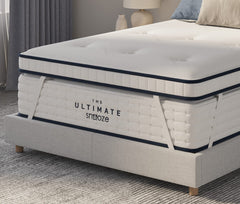
The Ultimate Snooze Organic Latex Mattress Topper
The only topper we make is 3 inches of GOLS-certified organic natural latex. Here is what that means in practice.
Breathable by design. Natural latex has an open-cell structure. The topper is perforated throughout to actively promote airflow through the material — drawing heat away from the sleep surface rather than accumulating it. For people sleeping on foam who have been sleeping hot, this change alone can be significant.
Responsive, not memory-retentive. Organic latex contours to body pressure and returns immediately when that pressure is released. It does not create the "stuck in the mattress" sensation of memory foam. It moves with you through the night without the full-body rethink that comes with repositioning on foam.
No off-gassing. No synthetic compounds. GOLS certification means the latex has been tested and verified. No petroleum compounds. No formaldehyde-releasing agents. No isocyanates. The faint natural latex scent dissipates in days. What remains is a clean sleep surface.
Covered in organic cotton and wool. The topper fabric maintains the same standards as the latex within it — certified organic cotton against the skin, organic wool for temperature regulation. No chemical finishes. No PFAS coatings.
Built to last. Natural latex has an expected lifespan several times longer than foam. The topper carries a 30-year limited warranty — a figure that reflects both the durability of the material and the confidence we have in how it is constructed.
The right use case: This topper is ideal over an existing organic mattress where you want to add a plush comfort layer without changing the support architecture below. It is also a meaningful upgrade over a conventional mattress for someone not yet ready to replace the full mattress — it removes the synthetic surface from the equation and replaces it with a clean, breathable, non-toxic comfort layer while the larger purchase decision is made.
If you are going to add a layer to your sleep surface, what that layer is made from affects the air you breathe for eight hours every night. A 3-inch organic latex topper is not a compromise. It is the right answer to a legitimate question.