








By Jacob Rivera, Creative Director at The Ultimate Snooze
Melatonin generated over $800 million in U.S. sales in 2020, making it one of the most purchased supplements in the country. Most of the people buying it are using it to fall asleep faster or sleep longer. The research on whether it works for those purposes is more nuanced — and more cautionary — than the marketing suggests.
What Melatonin Actually Does
Melatonin is a hormone produced by the pineal gland in response to darkness. Its primary function is not inducing sleep — it is signaling to the body's circadian clock that it is nighttime. It is a timing hormone, not a sedative. The distinction matters enormously for understanding when it works and when it does not.
The National Center for Complementary and Integrative Health summarizes the evidence clearly: melatonin is most effective for circadian rhythm disorders — jet lag, shift work disruption, delayed sleep phase syndrome — where the body's internal clock is misaligned with the desired sleep schedule. It is significantly less effective for primary insomnia, generalized difficulty falling or staying asleep, or sleep deprivation from poor sleep quality.
The Dose Problem
Most commercial melatonin supplements are sold in doses of 5mg to 10mg. Research published in the Journal of Biological Rhythms found that the physiologically effective dose for circadian signaling is approximately 0.1 to 0.3mg — roughly 10 to 50 times lower than typical over-the-counter dosing. Higher doses do not produce proportionally better results; they produce supraphysiological blood levels that can suppress the body's own melatonin production over time and shift sleep timing unpredictably.
The popularity of high-dose melatonin is largely a regulatory artifact: because melatonin is sold as a supplement rather than a drug in the U.S., there is no required efficacy testing and no dose standardization. The doses available are determined by what sells, not by what works.
When Melatonin Does Work
Jet lag: Strong evidence. Taking 0.5–3mg at the target destination's bedtime for two to three nights after crossing multiple time zones accelerates circadian re-entrainment. A Cochrane Review of melatonin for jet lag found it effective and well-tolerated when used correctly for this specific purpose.
Delayed sleep phase: People who cannot fall asleep until 2–4 AM and want to shift their schedule earlier benefit from low-dose melatonin taken 5–6 hours before their natural sleep onset. This works through circadian entrainment, not sedation.
Shift workers: Moderate evidence for improving daytime sleep quality in workers who sleep against their natural circadian phase.
When It Does Not Work
If you have difficulty falling asleep due to anxiety, rumination, elevated cortisol, or hyperarousal — melatonin taken at 10mg at bedtime is not the evidence-based intervention. The circadian clock is not the problem. The nervous system state is the problem. The APA's documented first-line treatment for chronic insomnia is Cognitive Behavioral Therapy for Insomnia (CBT-I), not melatonin — a distinction that most people purchasing melatonin supplements are not aware of.
If you wake at 3 AM and cannot return to sleep — melatonin does not address this. Middle-of-night waking is typically caused by sleep apnea, cortisol spikes, blood sugar fluctuations, or sleep architecture disruption from environmental factors. Taking more melatonin at 3 AM will dysregulate your morning cortisol rise and make tomorrow worse.
What the Research Recommends Instead
For general sleep quality improvement, the evidence hierarchy runs: sleep environment → sleep hygiene behaviors → CBT-I → targeted supplementation for specific deficiencies (magnesium glycinate for relaxation, vitamin D for those deficient, glycine for core temperature reduction) → melatonin only if circadian misalignment is the specific issue.
The sleep environment is first on that list because it is the most consistently overlooked variable. A bedroom that is too warm, a mattress that traps heat, VOCs from synthetic foam keeping the nervous system slightly activated — these environmental factors disrupt sleep architecture in ways that no supplement addresses. Melatonin does not fix a hot mattress. It does not counteract chemical off-gassing. It does not produce the deep sleep stages that the body is failing to reach because the surface beneath it is working against the thermal requirements those stages demand.
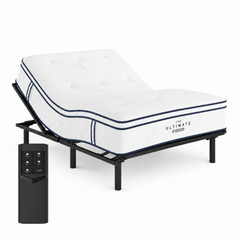
The Organic Mattress by Ultimate Snooze — organic natural latex, organic wool temperature regulation, zero synthetic off-gassing — addresses the environmental foundation that makes sleep architecture possible. Supplements can be useful at the margins. The environment determines the ceiling they are working under.