



A loud roommate is one of the most disruptive sleep problems — and most of the advice out there does not actually fix it.
Here is what the research says works, what does not, and how to build a sleep environment that lets you rest even when the noise outside your door does not stop.
Why Noise Wakes You Up (Even When You Are Tired)
Your brain never fully shuts off during sleep. It monitors your environment for potential threats — and sudden or unpredictable sounds trigger a stress response that pulls you toward waking, even from deep sleep.
The most disruptive noises are not necessarily the loudest. They are the ones that are inconsistent — a door slamming, music that stops and starts, a conversation that gets louder then quieter. Your brain tracks the pattern and stays alert because it cannot predict what comes next.
This is why a loud roommate is harder to sleep through than a steady noise like a fan or rain. The unpredictability is the problem.
What Does Not Work
Trying to ignore it. Willpower does not override the autonomic nervous system. You cannot decide to stop responding to noise during light sleep stages.
Earplugs alone. Foam earplugs reduce noise by around 30 decibels. They help with very loud environments but do not eliminate the disruption from variable sounds.
Music with lyrics. Your brain tracks melody, rhythm, and language even during sleep. Putting on a song you like to drift off can actually keep you in lighter sleep stages because your brain keeps listening.
Hoping they will be quieter tonight. If the noise is predictable — a roommate who is always up late — plan around it rather than hoping for a different outcome.
What Actually Works
Masking Noise With Consistent Sound
The most effective strategy is not silence. It is replacing unpredictable noise with a consistent, steady sound that gives your brain something neutral to settle into.
This is called acoustic masking, and it is the science behind white noise machines, pink noise playlists, and brown noise tracks.
A consistent masking sound does two things. It narrows the contrast between loud moments and quiet moments, which is what wakes light sleepers. And over time it becomes a sleep cue — your brain learns to associate that sound with rest.
Pink Noise, Brown Noise, or White Noise — Which One?
White noise has equal energy across all frequencies. It sounds like static — sharp and high-pitched. Effective for noise masking but some people find it harsh over time.
Pink noise has more energy at lower frequencies. It sounds like rain, a waterfall, or steady wind — fuller and more natural. Research suggests it may also enhance slow-wave (deep) sleep.
Brown noise has even more power at the lower end. It sounds like a deep rumble — ocean waves, a running shower. The deepest and warmest of the three.
For a loud roommate specifically, pink noise or brown noise tends to be more effective because they mask mid-to-low frequency sounds better than white noise — which is also where most human voices and music live.
Start with pink noise and adjust from there. Most people find they prefer it within a few nights.
Sleep Earbuds or a Bluetooth Speaker
A speaker placed across the room at low volume is often more effective than earbuds. It creates an ambient field of sound rather than sound delivered directly into one ear.
If you prefer earbuds, use sleep-specific ones (flat profile, designed to stay in while lying down) rather than regular earbuds, which become uncomfortable quickly.
Set a Sleep Timer
You do not need the noise playing all night. Most people fall asleep within 20 to 30 minutes if they remove the obstacles to sleep onset. Use a sleep timer set to 45 minutes and let the sound carry you across the threshold.
Your Sleep Surface Matters Too
Masking sound helps you fall asleep. But staying asleep — especially in a disrupted environment — also depends on how much your body is working to find comfort throughout the night.
A mattress that creates pressure points, sleeps hot, or transfers motion from your partner will pull you into light sleep even when the room is quiet. When environmental noise is already a challenge, you need your sleep surface working with you, not against you.
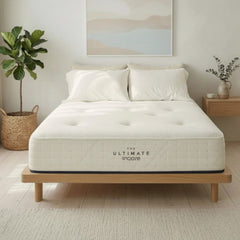
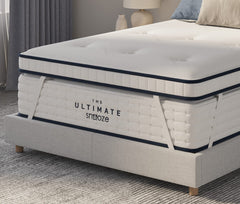
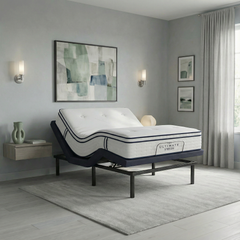
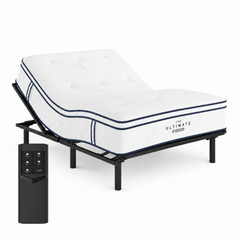
The Ultimate Snooze Recovery Organic Latex Mattress uses open-cell organic Talalay latex and 1,100-count pocketed coils that isolate motion and provide responsive pressure relief — so your body can stay in a comfortable position without constantly adjusting.
Paired with a pink noise playlist, it removes two of the most common causes of disrupted sleep at once.
A Simple Routine That Works
- Start a pink noise or brown noise playlist 20 to 30 minutes before bed — keep volume low but present
- Keep the room as dark as possible — blackout curtains help if light comes under the door
- Use a door draft blocker if hallway sounds are the issue
- Set a 45-minute sleep timer on your playlist
- Phone face down, screen off, away from the bed
You cannot control what your roommate does. You can control your environment.
Best Playlists for Sleeping With Noise
For specific pink noise, brown noise, and sleep sound playlist recommendations on Spotify and Apple Music, see our full guide: Best Sleep Sounds Playlists on Spotify and Apple Music in 2026.
Final Thought
The goal is not silence. The goal is consistency. Give your brain something neutral and steady to settle into, reduce the contrast between your roommate's noise and the quiet moments, and build a sleep environment that works even when everything outside your door does not.
That is how you fall asleep when you cannot control the noise.
)