







You have heard of white noise. But pink noise and brown noise are getting more attention — and the research behind them is more interesting than most people realize.
Here is a clear breakdown of what each one is, how they differ acoustically, what the science says about sleep, and how to choose the right one for your needs.
What Is White Noise?
White noise contains equal energy at every frequency across the audible spectrum — from the lowest bass tones to the highest treble. Because every frequency is represented equally, it produces a hissing, static-like sound.
White noise gets its name from white light, which contains all wavelengths of the visible spectrum equally.
It is effective at masking sudden intrusive sounds because it creates a consistent acoustic baseline. Any sharp noise — a door slam, a car horn — is harder to detect when it occurs against a steady background.
The limitation is that many people find white noise harsh, particularly over long periods. The higher frequencies that are present in equal measure can feel abrasive, especially for light sleepers.
What Is Pink Noise?
Pink noise has more energy at lower frequencies and progressively less energy as frequencies increase. Technically, its power decreases by 3 decibels per octave as you move up the frequency range.
This gives pink noise a warmer, fuller sound — more like steady rain, a waterfall, or wind through trees than the sharp hiss of white noise. It is often described as more natural and more comfortable to listen to over extended periods.
Pink noise is also called 1/f noise because power is inversely proportional to frequency — a mathematical relationship found throughout nature in everything from heartbeats to tidal patterns.
What the research says: A 2012 study published in Neuron found that pink noise delivered in sync with slow brain oscillations during sleep significantly enhanced slow-wave sleep and improved memory consolidation the following day. A 2017 study in Frontiers in Human Neuroscience showed that acoustic stimulation using pink noise synchronized with sleep oscillations produced measurable improvements in sleep quality in older adults. These findings are preliminary and ongoing, but pink noise has more sleep-specific research behind it than white or brown noise.
What Is Brown Noise?
Brown noise (also called red noise) has even more power concentrated at low frequencies. As frequency increases, energy drops by 6 decibels per octave — twice the roll-off of pink noise.
The result is a deep, rumbling sound — like ocean waves, heavy rain, or a running shower turned up. Some people describe it as being inside a large engine at idle.
Brown noise does not have the sleep-specific research that pink noise does, but many people find it easier to sleep with than white noise because the complete absence of high-frequency harshness makes it more comfortable over long periods.
It is particularly effective at masking low-frequency environmental sounds — traffic, bass from music in nearby rooms, HVAC systems.
How to Choose the Right One
Choose white noise if you need aggressive masking of sharp, high-pitched sounds — and do not find the static feel bothersome.
Choose pink noise if white noise sounds too harsh, or if you want the option with the most sleep-specific research behind it. This is a good default starting point for most people.
Choose brown noise if you sleep in an environment with a lot of low-frequency sound (traffic, nearby bass), or if you simply find deeper, warmer sound more comfortable.
There is no universally correct answer. Individual response to these sounds varies significantly, and the best noise for sleep is the one that helps you specifically feel calm and stay asleep.
Where to Find Pink, White, and Brown Noise Playlists
Both Spotify and Apple Music have dedicated playlists for each noise type.
On Apple Music, the White Noise playlist (search "White Noise" in playlists) includes white, pink, grey, and brown noise tracks in a single playlist — a good way to try all three and find what works for you.
On Spotify, search for "pink noise sleep" or "brown noise" to find playlists dedicated to each. The quality varies; look for playlists with long continuous tracks rather than short loops that reset.
For a full list of curated recommendations, see our guide to Best Sleep Sounds Playlists on Spotify and Apple Music in 2026.
How to Use Sleep Noise Effectively
Volume matters. The goal is a consistent background presence, not loud masking. Keep volume at or below conversation level — loud enough to notice, not loud enough to focus on.
Use a sleep timer. You do not need the sound running all night. Setting a 45 to 60 minute timer is enough for most people to pass through sleep onset.
Use a speaker rather than earbuds when possible. A speaker creates an ambient field of sound around the room rather than delivering it directly into one ear.
Be consistent. Sleep sounds become more effective over time as your brain builds an association between the sound and rest.
Sound Is One Part of the Sleep Environment
Pink noise and consistent sound help calm what you hear. But sleep quality also depends on what you physically sleep on.
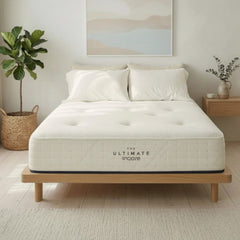
A mattress that sleeps hot, creates pressure points, or transfers motion disrupts sleep regardless of how good your sound environment is. The Ultimate Snooze organic latex mattresses use open-cell latex for airflow, organic wool for temperature regulation, and pocketed coil systems for motion isolation — so the environment you sleep in addresses both sound and surface at once.
Frequently Asked Questions
Is pink noise better than white noise for sleep?
Research suggests pink noise may enhance slow-wave sleep and memory consolidation. It is also more comfortable for most people to listen to over extended periods. For general sleep use, pink noise is a reasonable first choice.
What does brown noise do for sleep?
Brown noise has a deep, low-frequency profile that many people find calming. It is effective at masking low-frequency environmental sounds. It does not have the specific sleep research that pink noise does, but subjective comfort is a meaningful factor.
Can you play pink noise all night?
Yes, at low volume this is generally considered safe. Using a sleep timer is still recommended so the sound stops after sleep onset if you prefer not to have it running the entire night.
Is pink noise on Apple Music?
Yes. Apple Music's White Noise playlist includes pink noise, grey noise, and brown noise tracks alongside white noise. Search "White Noise" in playlists to find it.
Final Thought
White noise, pink noise, and brown noise each have a place depending on your environment and preferences. Pink noise has the most sleep-specific research. Brown noise is the most comfortable for many listeners. White noise is the most aggressive masker.
Try pink noise first. Adjust based on what your environment and your nervous system respond to. Consistency and low volume matter more than which specific noise type you choose.