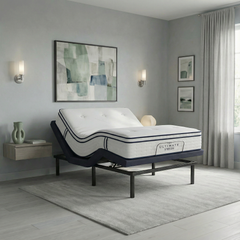
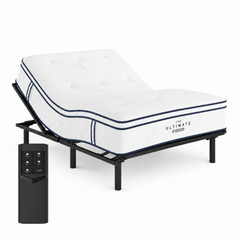




Short answer: You can find a mattress for under $200 — a bare-bones foam bed with a 1–3 year expected lifespan and little to no real warranty. Whether that's actually the "lowest cost" option depends on how you're doing the math. Priced per night of use over the life of the mattress, a low sticker price paired with a short lifespan can easily end up costing more than a higher-priced, longer-lasting mattress. That's the math we want to walk through here.
Two Ways to Answer "What's the Lowest Cost Mattress?"
There are really two different questions hiding inside that search:
- "What has the lowest price tag?" — easy to answer, and not that useful on its own.
- "What actually costs the least, over time, to sleep on every night?" — harder to answer, and the one that actually affects your wallet.
The Ultimate Snooze is not the answer to the first question. We don't compete to be the cheapest mattress you can buy. We're built to be one of the best answers to the second one.
The Formula: Price ÷ Years ÷ 365
To compare mattresses fairly, divide the price by the number of nights you'll actually get real use out of it — a reasonable proxy being the warrantied lifespan, since that's the period the manufacturer is confident the mattress will perform:
Daily Value = Price ÷ (Warranty Years × 365)
Worked Example: Our Queen Mattress
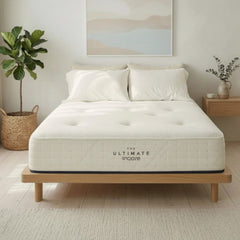
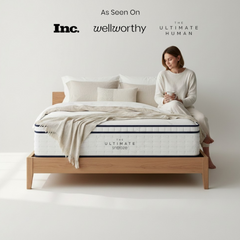
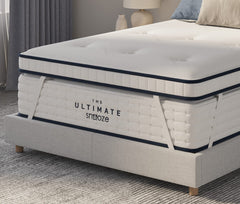
The Ultimate Snooze Pure Organic Latex Mattress in Queen is $2,639.99, backed by a 30-year warranty (20 years fully non-prorated). Run the math:
- Over the full 30-year warranty: $2,639.99 ÷ 10,950 nights = about $0.24 per night
- Over just the 20-year non-prorated period: $2,639.99 ÷ 7,300 nights = about $0.36 per night
Now compare that to a typical budget mattress. A $500 mattress with an average real-world lifespan of 7 years (a common figure for entry-level foam beds, per mattress industry lifespan estimates) works out to $500 ÷ 2,555 nights = about $0.20 per night — genuinely cheap, if it actually lasts the full 7 years and you don't mind replacing it that often.
But a $500 mattress that sags or breaks down in 3 years — not unusual for the lowest end of the foam market — works out to $500 ÷ 1,095 nights = about $0.46 per night, nearly double what our 30-year mattress costs per night, plus the hassle and expense of replacing it three separate times over the same 30-year span.
Why Warranty Length Is a Reasonable Stand-In for Lifespan
A manufacturer's warranty term is effectively a public statement of how long they expect the materials to hold up under normal use. Mainstream foam and hybrid mattresses typically carry 10-year non-prorated warranties; many budget models offer far less. The Ultimate Snooze's 30-year warranty (20 years non-prorated) reflects the durability of GOLS-certified organic latex, which resists the sagging and body impressions that end the useful life of cheaper foam mattresses years earlier.
What "Cheap" Usually Leaves Out
The lowest sticker-price mattresses typically use lower-density foams, synthetic fillers, and minimal edge support — the exact things that shorten a mattress's usable life and drive down its per-night value even though the upfront number looks appealing. They also tend to carry the shortest warranties in the industry, which is itself a signal of how long the manufacturer expects them to last.
Bottom Line
If low upfront price is your only filter, you'll find cheaper mattresses than ours — that's true, and we're not going to pretend otherwise. But run the price through the years and nights it actually needs to last, and a 30-year, 100-night-trial mattress built on durable organic latex can end up being the genuinely lower-cost choice, not just the lower-priced one.
)