


By Jacob Rivera, Creative Director at The Ultimate Snooze
Temperature does not feel like a health topic. It feels like a preference — some people run warm, some run cold, and the solution is another blanket or a fan in the corner. But the relationship between body temperature and sleep quality is not about comfort. It is about biology. And understanding it reframes almost every decision you make about your sleep environment.
The Body Temperature Requirement for Deep Sleep
To enter and sustain slow-wave (deep) sleep, your core body temperature must drop approximately 1 to 2 degrees Fahrenheit from its daytime peak. This is not a preference or a loose correlation. It is a prerequisite — a biological threshold the body must cross before the neural mechanisms that produce slow-wave sleep will activate.
Research published in the journal Sleep Medicine Reviews documented the direct relationship between thermoregulation and sleep architecture, finding that the body's circadian temperature rhythm — its internal 24-hour cycle of rising and falling core temperature — is one of the strongest biological drivers of when and how deeply we sleep. The temperature begins to drop in the early evening, reaches its nadir around 4 to 5 AM, and rises again as the body prepares to wake. Slow-wave sleep is most abundant in the early part of the night, precisely aligned with the steepest portion of that temperature descent.
Research in the Journal of Physiology confirmed that manipulating skin temperature during sleep — warming it artificially — directly reduces slow-wave sleep duration and shifts the brain toward lighter, more fragmented sleep stages. This is not a marginal effect. The researchers observed measurable reductions in deep sleep from temperature changes as small as one degree Celsius at the skin surface.
Why the Sleep Surface Is the Thermal Variable Most People Miss
The bedroom thermostat gets most of the attention in sleep temperature conversations. The ideal ambient temperature for sleep — widely cited between 65 and 68°F — is real and relevant. But the mattress surface temperature, which is in direct contact with the body for the entire night, operates as a second and often more impactful thermal variable that most discussions skip entirely.
Polyurethane foam is a petroleum-based material. Its thermal properties are those of a closed-cell polymer: it absorbs metabolic heat, holds it against the body, and does not release it. A person sleeping on a foam mattress is sleeping on an increasingly warm surface throughout the night — one that actively works against the core temperature descent that deep sleep requires.
Research in the Journal of Physiological Anthropology found a direct, measurable relationship between elevated skin temperature at the sleep surface and reduced time in slow-wave sleep, with participants on warmer surfaces spending significantly more time in light sleep stages and reporting lower subjective sleep quality regardless of the ambient room temperature. The room was cool. The mattress was not. It mattered.
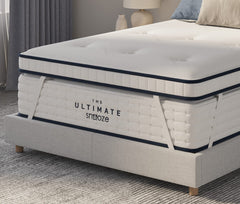
This is one of the reasons the Gary Brecka Organic Mattress — the Pillow Top Organic Latex Mattress designed by Gary Brecka — is built with organic natural latex as its core comfort layer rather than any form of foam. Natural latex has an open-cell structure with breathable pinhole perforations throughout the 4-inch comfort layer. Heat moves through it rather than accumulating in it. The sleep surface temperature stays lower across the night — aligned with what the body needs to initiate and sustain the deep sleep stages where real restoration happens.
What Organic Materials Do for Sleep Thermoregulation
Organic natural latex: The open-cell, perforated structure of GOLS-certified organic latex allows continuous airflow through the comfort layer. Unlike foam, which absorbs heat and radiates it back toward the body, latex dissipates it. The thermal properties are fundamentally different because the materials are fundamentally different — not petroleum-derived polymer, but vulcanized rubber tree sap with a biological structure that breathes.
Organic wool: Wool is one of the most effective natural thermoregulators available. It wicks moisture vapor from the skin surface (perspiration before it becomes sweat), releases it into the surrounding air, and in doing so actively cools the skin through evaporative heat loss. Research from the Woolmark Company documented that wool bedding produces measurably lower microclimate temperatures — the air immediately surrounding the body during sleep — compared to synthetic alternatives, with corresponding improvements in sleep efficiency and deep sleep duration in study participants.
Organic cotton and linen sheets: Natural fiber sheets breathe. They absorb perspiration into the fiber and release it as vapor rather than holding moisture against the skin. The thermal comfort difference between sleeping in organic cotton sheets and synthetic microfiber is measurable and accumulates across the full night — every degree of unnecessary surface warmth is a degree that works against the temperature environment your body is trying to maintain.
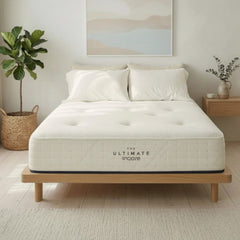
The Organic Mattress by Ultimate Snooze — both the Pure and the Pillow Top — pairs organic natural latex and organic wool in a system designed around this thermoregulatory biology. The latex dissipates heat through the mattress. The wool draws moisture from the surface and releases it. The organic cotton cover breathes. The result is a sleep surface that works with the body's temperature requirements rather than against them.
Practical Steps to Lower Your Sleep Surface Temperature
Set the bedroom to 65–68°F — the ambient temperature range most consistently associated with optimal sleep in the research. If this feels too cold when you first get into bed, note that your body will adapt quickly once sleep onset begins and the core temperature drop accelerates.
Take a warm shower 60–90 minutes before bed. This sounds counterintuitive, but it works. The warm water raises skin temperature, triggering the body's heat-dissipation response. When you step out of the shower, the blood vessels near the skin dilate and release heat rapidly, accelerating the core temperature drop that initiates sleep. A meta-analysis in Sleep Medicine Reviews found that this technique, called passive body heating, consistently reduced sleep onset time by an average of 10 minutes across studies.
Choose natural fiber bedding. The thermal performance difference between organic cotton or linen sheets and synthetic microfiber is real and accumulates across the night. The sheet layer is in contact with the body the entire time — its thermal and moisture management properties matter.
Address the mattress. Room temperature optimization produces partial results on a heat-trapping foam surface. If the mattress is working against your thermoregulation, everything above it is compensating for a problem rather than solving it.
Gary Brecka Organic Mattress — Pillow Top Organic Latex (Medium Plush)
Pure Organic Latex Mattress — Medium Firm